

Roller Skate Wheels: The Ultimate Guide to Finding Your Perfect Roll in 2026
What if your high-end skates are actually being held back by a few millimeters of urethane? Your roller skate wheels are the transmission of your entire setup; picking the wrong durometer is the fastest way to ruin a great session. Whether you are eyeing a $20 set of Rainbow Riders or the $69 Radar Halos, the numbers on the side of that plastic determine if you'll fly or flop. We know it's frustrating to stare at a 78A rating and wonder if it will handle the rough asphalt of 2026. It's even worse when you realize too late that you only bought a single 4-pack for a quad skate that needs eight wheels.
You deserve a ride that feels like royalty without the royal price tag. We promise to help you master the technical specs of diameter and urethane so you can roll faster and smoother than ever before. This guide breaks down the latest 2026 World Skate regulations and compares the hottest new gear like the K2 Booster 80A packs. We'll show you exactly how to choose the grip that fits your style, ensuring your next session is nothing but epic. Let's get those skates dialed in!
Key Takeaways
- Decode the technical specs of durometer to find the perfect sweet spot between blazing speed and rock-solid stability.
- Never get stranded mid-session again by learning the essential math for buying roller skate wheels in the correct quantities for quads.
- Master the physics of grip to ensure a vibration-free outdoor ride or a slip-free experience on slick rink floors.
- Extend the life of your urethane and keep your roll royally smooth with our 180-degree rotation maintenance tips.
- Discover how to snag pro-level upgrades from a wide range of manufacturers, keeping your budget epic with Low Price Skates.
Table of Contents
- New Wheels, Who Dis? Why Your Roller Skate Wheels Matter
- Durometer and Diameter: Decoding the Tech of the Roll
- Indoor vs. Outdoor Wheels: Mastering Every Surface
- Maintenance and Replacement: Keeping Your Roll Royally Smooth
- Upgrade Your Setup: Why Low Price Skates is Your Epic Pro Shop
New Wheels, Who Dis? Why Your Roller Skate Wheels Matter
Stop blaming your boots for a bumpy ride! If your skates feel sluggish or vibrate like a jackhammer on the sidewalk, your wheels are likely the culprit. Think of your roller skate wheels as the transmission of your setup. They are the only part of your gear actually touching the ground, meaning they handle all the power transfer and energy return from every stride. You don't need to drop hundreds on a new pair of skates to feel a massive difference. A simple wheel swap can transform your experience from "meh" to absolutely epic in minutes. New skaters often struggle with balance or speed and assume they bought the wrong boots, but a fresh set of urethane is usually the missing link to a royally smooth roll.
The Anatomy of a Quad Skate Wheel
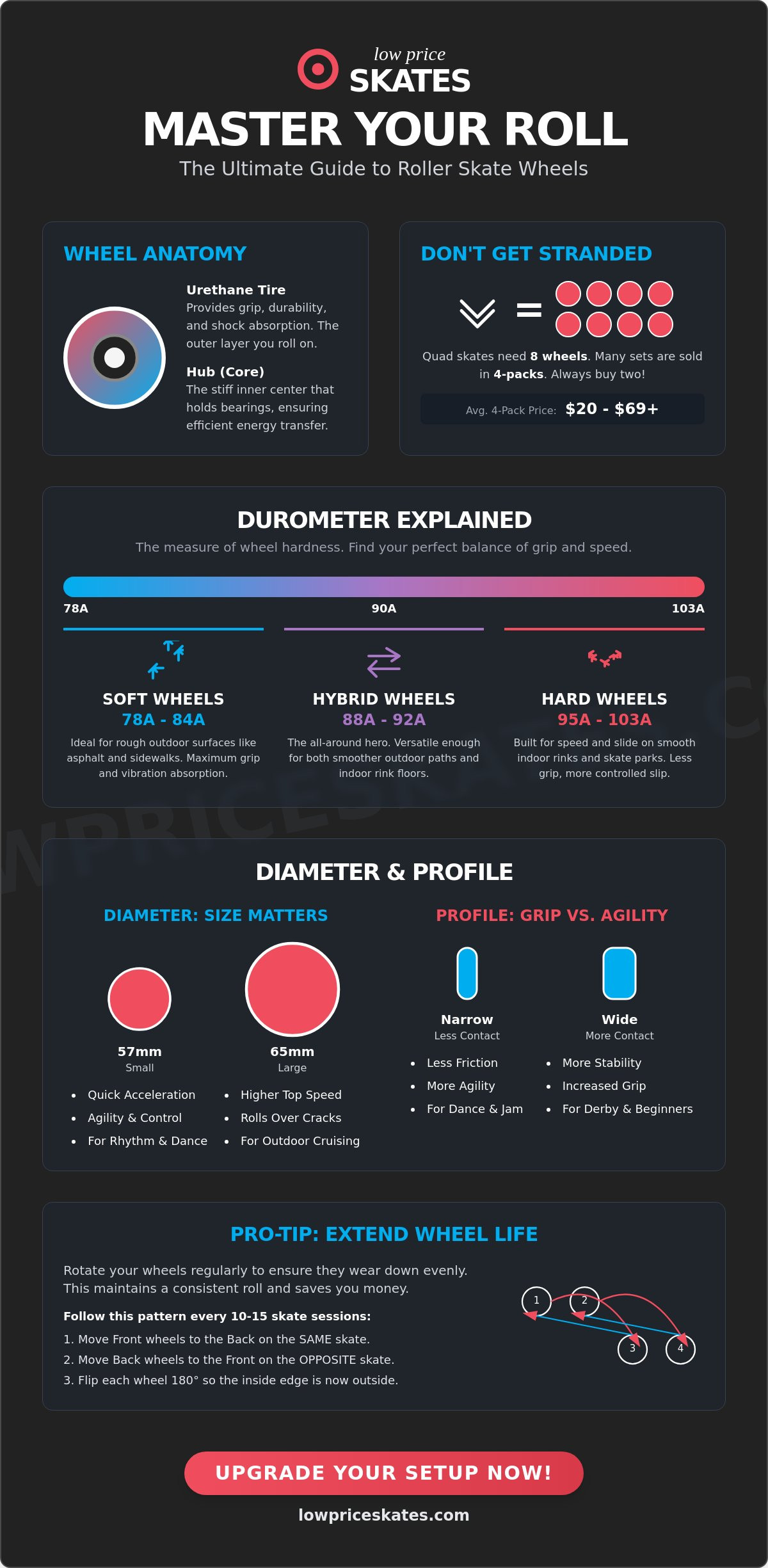
Every wheel is a two-part masterpiece. First, you have the hub, or the core. This is the stiff center that holds your bearings in place. A high-quality hub ensures your energy doesn't get lost in "mushy" flexing when you push off for a sprint. Surrounding that core is the tire, which is made of polyurethane. Polyurethane is a resilient, synthetic polymer that provides the perfect balance of grip, durability, and shock absorption for modern skating. Precision in the bearing seat is vital. If that seat isn't perfectly aligned, your wheels will wobble, killing your top speed. While quad designs are unique, much of the precision we see today stems from inline skate wheel technology, which helped standardize high-rebound materials across the industry.
Pack Sizes: The 4-Pack vs. 8-Pack Trap
Avoid the heartbreak of a half-finished skate! Many premium roller skate wheels are sold in 4-packs rather than full sets of eight. Brands do this so you can mix and match colors or hardness levels for a custom, royally cool aesthetic. For example, the K2 Booster 72mm packs released in 2026 are frequently sold in these smaller quantities. If you are riding quads, you must buy two packs to finish the job. As of May 2026, prices for a 4-pack can range from $20.00 for entry-level wheels to over $69.00 for professional-grade derby gear. Buying in bulk or looking for "closeout" 8-packs is a smart way to snag a deal while ensuring your setup is consistent. Mixing a "blazing" red pack with a neon blue pack isn't just about style; it's about making your skates uniquely yours while saving your wallet from unnecessary strain.
Durometer and Diameter: Decoding the Tech of the Roll
Ready to geek out? If you want to dominate the rink or the road, you have to speak the language of urethane. Durometer is the technical measurement of a wheel's hardness, usually marked with a number followed by the letter "A." This number tells you exactly how much "squish" your roller skate wheels have. A lower number like 78A means the wheel is soft and gummy, while a 101A is rock hard. But don't just look at the number. You also need to consider the rebound. High-quality wheels use premium urethane that acts like a tiny trampoline, springing back into shape after every stride to give you free energy. Cheap, plastic-heavy wheels have zero rebound; they feel "dead" and sluggish. Since the early history of roller skating, we've evolved from wood and metal to these high-tech polymers that make a smooth ride possible.
Diameter is the other half of the performance puzzle. This is the height of the wheel measured in millimeters. Larger wheels provide a higher top speed and a smoother ride over cracks, while smaller wheels offer lightning-fast acceleration and a lower center of gravity. You also have to think about the contact patch, which is the width of the wheel that actually touches the floor. A wider contact patch gives you "royally cool" stability, making it perfect for beginners or derby blockers. A narrow patch reduces friction, allowing for the agility needed in dance or technical footwork. If you're tired of guessing, you can browse our curated selection of roller skate wheels to see exactly how different specs change your roll.
The Durometer Spectrum: From 78A to 103A
Soft wheels (78A to 84A) are the ultimate choice for outdoor cruising. They absorb vibrations from rough asphalt and pebbles so your legs don't go numb. On the flip side, hard wheels (95A to 103A) are built for the "slide" feel. These are your best friends for indoor rinks and skate parks where you want to spin and shuffle without sticking to the floor. If you can't decide, look for the hybrid hero sweet spot around 88A to 92A. These wheels offer enough grip for a dusty floor but enough speed to keep you ahead of the pack.
Diameter Decisions: 57mm vs. 65mm
Size matters! A small 57mm wheel is the go-to for rhythm and dance because it allows for incredibly quick footwork. You'll feel agile and light on your feet. If you're hitting the trails for a long-distance trek, jump up to a 62mm or 65mm wheel. These larger sizes maintain momentum much better, meaning you don't have to work nearly as hard to stay at top speed. Just make sure your skate plate has enough clearance for the height. A wheel that's too tall might rub against your boot, and that's a recipe for an epic wipeout!
Indoor vs. Outdoor Wheels: Mastering Every Surface
Taking your 101A indoor roller skate wheels out for a spin on a cracked sidewalk is a recipe for a "wheel-y" bad time. Those hard wheels won't absorb a thing. Every pebble becomes a potential trip hazard that could send you flying. Outdoor wheels are usually 78A, which means they are soft enough to compress when they hit a small stone. This compression allows the wheel to roll over the obstacle instead of stopping dead. Understanding the material science of skate wheels helps you see why polyurethane is so vital. It manages rolling resistance while providing the necessary grip for your specific terrain. Whether you're blazing through a park or carving a wood floor, the surface dictates your gear choice.
To help you choose, here is our epic Surface to Hardness Cheat Sheet for 2026:
- Rough Asphalt/Roads: 78A (Maximum shock absorption)
- Smooth Sidewalks/Concrete: 82A to 85A (Balanced speed and grip)
- Sport Court/Plastic Tiles: 88A to 93A (The hybrid sweet spot)
- Polished Wood Rink: 95A to 101A (Maximum speed and slide)
- Slick/Dirty Rink Floors: 92A to 94A (Extra "bite" for safety)
Outdoor Skating: Conquering the Concrete
If you love the allure of the open road, gummy urethane is your best friend. These wheels are designed to soak up road vibration so your legs don't feel like jelly after ten minutes. Atom Poison wheels remain a gold standard here. They act as a hybrid hero, offering enough grip for slick outdoor spots but enough roll for a smooth trail. High-rebound outdoor roller skate wheels prevent "pebble stops," where a tiny rock halts a hard wheel instantly. By choosing a softer rating, you're investing in a royally smooth ride that keeps you upright and confident on unpredictable terrain.
Indoor Excellence: Rinks, Derby, and Dance
Indoor skating is all about the "Grip vs. Slide" debate. In roller derby, you need enough grip to hold a tight corner but enough slide to execute a plow stop. If the floor is a freshly coated wood, you'll want a harder wheel (97A+) to minimize energy loss. On a dusty or slippery concrete rink, dropping down to a 93A can give you the traction you need to stay in control. Rhythm and dance skaters often prefer a very hard wheel to make spins and slides feel effortless. According to the 2026 World Skate specifications, professional setups can vary wildly, but the goal is always the same: finding that epic balance that lets you roll with royalty.
Maintenance and Replacement: Keeping Your Roll Royally Smooth
Don't let your gear turn into a bumpy mess! Even the best roller skate wheels need a little TLC to keep rolling with royalty. If you start feeling a weird vibration or notice your skates pulling to one side, it's time for a pit stop. Maintenance isn't just about cleaning off the rink gunk; it's about protecting your investment. You need to check for "chunking," where the urethane starts to peel away from the hub. This usually happens after a rough outdoor session or a heavy-hitting derby bout. Also, keep an eye on your bearings. Most modern quads use 8mm bearings, but some high-end artistic plates require 7mm. If the fit isn't snug, your roll will be anything but smooth.
Cleaning is simple but vital. Use a damp cloth to wipe away dust and hair from the urethane and the hub. Avoid soaking your wheels in harsh chemicals, as this can degrade the polyurethane or damage the bearing seat. A clean wheel grips better and looks royally cool under the disco lights. Keep them shiny, keep them rotated, and you'll stay blazing the streets for months to come! If you also take that same pride in your vehicle's appearance, you can visit SKY MAXPRO for professional-grade cleaning and restoration kits.
Diagnosing Your Wear Patterns
Take a close look at the shape of your urethane. Are your wheels starting to look like cones? Coning happens when you favor your inside edges, which is common for beginners finding their balance. It's a sign you need to rotate immediately! Flat spots are another session-killer. These occur when you execute a hard T-stop on a hard wheel, literally shaving off a flat section of the circle. If your wheel has lost more than 5mm of its original diameter, it's time to retire it. Safety first! A significantly smaller wheel changes your center of gravity and can lead to an unexpected wipeout.
The Pro Shop Secret: Wheel Rotation
The secret to a long-lasting setup is the 180-degree flip. We recommend the "X" pattern for quad skates. Move your front-left wheel to the back-right position, and your front-right to the back-left. Perform this swap every 2 to 4 weeks if you're a regular at the rink. This ensures even wear across all eight roller skate wheels. All you need is a standard T-tool to make the swap in under five minutes. Ready to refresh your setup? Grab a new set of wheels today and feel the difference of a fresh, epic roll!
Upgrade Your Setup: Why Low Price Skates is Your Epic Pro Shop
Your search for the perfect roll ends here! At Low Price Skates, we don't just sell gear; we live for the glide. We've curated a selection of the world's best roller skate wheels from heavy hitters like Riedell, Moxi, and Atom. Why settle for "meh" when you can roll with royalty? Our "cool mentor" team consists of industry veterans who know exactly which durometer fits your local rink or varied outdoor terrains. We take your equipment and your savings seriously. That is why our "Lowest Prices Guaranteed!" slogan isn't just a catchy phrase. It's a promise that you're getting pro-level urethane without the pro-level price tag. Every order ships fast from our central distribution hub, reaching skaters nationwide in record time.
We know that navigating the technical world of urethane can be a headache. That is why we do the heavy lifting for you. We test the latest 2026 releases to ensure they meet our high standards for agility and durability. Whether you need an 8-pack for your quads or a specific 4-pack to mix and match colors, our inventory is always stocked and ready to go. We're enthusiasts who want to make the sport accessible to everyone. From budget-friendly closeouts to the most "blazing" new arrivals, we make sure you look good and save money simultaneously.
Top Picks for Every Style
Choosing the right gear is easier when you have an expert-vetted list. For those who love the allure of the open road, the Moxi Gummy and Radar Energy wheels are unbeatable. They offer the 78A softness you need to soak up every vibration from the asphalt. If you're heading to the rink, check out the Riedell Sonar or Rollerbones Team wheels. These provide the crisp "slide" feel required for technical rhythm and dance. For the competitive spirits, the Atom Poison and Poison Savant are hybrid heroes. They provide the speed and grip needed to dominate the derby track. No matter your style, we have the roller skate wheels that will make your setup feel truly epic.
Ready to Blaze the Streets?
You've mastered the tech of durometer. You know how to rotate your sets and keep them clean. Now, it is time to put that knowledge into action. Don't let worn-out, flat-spotted wheels hold back your potential. Whether you are a beginner looking for your first performance upgrade or a seasoned pro hunting for a deal, we have you covered. Our community-focused spirit means we are always here to help you find the perfect match for your skates and your budget. Grab your gear, lace up, and get ready to experience a ride that is smoother than ever. Shop all Roller Skate Wheels and save!
Ready to Roll with Royalty?
You've got the tech. You've got the tools. Now, it's time to hit the pavement or the rink with total confidence! Mastering the science of roller skate wheels means you no longer have to settle for a "meh" ride. Whether you are chasing the gummy 78A feel for a vibration-free outdoor cruise or the 101A slide for technical rhythm dance, the perfect setup is finally within reach. Don't forget to use that "X" pattern rotation every 2 to 4 weeks to keep your urethane in peak condition for the long haul.
At Low Price Skates, our team of industry experts has decades of experience to help you find your epic match. We carry a vast inventory of top-tier brands like Riedell and Moxi, ensuring you always have access to the latest 2026 gear. With our Lowest Prices Guaranteed!, you can upgrade your setup without breaking the bank. It's time to stop dreaming and start rolling! Blaze the streets with a new set of wheels from Low Price Skates! We can't wait to see you out there making every session legendary.
Frequently Asked Questions
Do roller skate wheels come with bearings?
No, most high-quality roller skate wheels are sold without bearings. This allows you to choose the specific speed and durability level of your bearings independently. If you are buying a complete beginner set, they might be included, but for pro-level gear like Moxi or Riedell, expect to buy 16 bearings to fill your eight new wheels. It's a great way to customize your roll for maximum agility!
Can I use outdoor wheels at the skating rink?
You can use outdoor wheels at the rink, but it will feel like you're skating through molasses! Soft outdoor urethane (78A) grips the polished floor too tightly. This creates massive rolling resistance, making you work twice as hard to maintain speed. It's safe for beginners who want extra stability, but seasoned pros will find it sluggish. Stick to harder wheels for that royally smooth rink glide.
What is the best durometer for skating on asphalt?
A 78A durometer is the absolute best choice for rough asphalt and bumpy sidewalks. This gummy rating provides the maximum shock absorption needed to handle pebbles and cracks without rattling your teeth. If the pavement is exceptionally smooth, you might bump up to an 82A or 84A for a bit more speed. As of May 2026, the 78A remains the top-selling outdoor spec for fitness skaters.
How many wheels do I need to buy for a pair of skates?
You need exactly eight wheels for a full pair of quad skates. Be careful when shopping! Many premium brands sell their roller skate wheels in 4-packs to let you mix colors for a custom look. This means you must add two packs to your cart to complete your setup. It's a common mistake that leads to a "wheel-y" bad time when only half your order arrives at your door.
What is the difference between 57mm and 62mm wheels?
The main difference is agility versus momentum. A 57mm wheel is smaller and lower to the ground, making it the epic choice for rhythm skating and quick footwork. A 62mm wheel is taller, which helps you maintain top speed and roll over debris more easily. If you want to blaze the streets for long distances, go big. If you want to spin and dance, go small.
Why are my roller skate wheels making a clicking sound?
A clicking sound usually means a bearing is not fully seated in the hub. If the bearing can wiggle even a fraction of a millimeter, it will click every time the wheel rotates. It could also be a grain of sand stuck between the bearing and the hub. Pop the wheel off, use your T-tool to press the bearings in firmly, and ensure your axle nuts are snug.
Can I mix different hardnesses of wheels on one skate?
Absolutely! Mixing hardness levels is a pro move known as a pusher setup. Many derby skaters put grippier wheels on the inside edges of their skates to help with crossovers and harder wheels on the outside for speed. It's a royally cool way to fine-tune your performance for specific floor conditions. Just make sure the diameters match perfectly so your skates stay level and stable during turns.
How long do roller skate wheels typically last?
Most wheels last between 6 to 12 months for the average active skater. If you're hitting the pavement daily, you'll see wear much faster than a weekend rink skater. Regular rotation using the X pattern we mentioned earlier can extend their life by 30 percent. Once the diameter has shrunk by 5mm or you notice chunking in the urethane, it's time to shop for a fresh set.
- Choosing a selection results in a full page refresh.
!